Culture Scorecard
Turn culture from a conversation into a measurable strategy
How Important is Culture in Your Organization?
And How Do You Measure It?
If you didn't have a tool to measure culture, now it is your opportunity to get one for your organization.
We introduce The Culture Health Scorecard.
The Culture Health Scorecard provides leaders with a clear, data-driven snapshot of how culture is actually showing up across the organization. It replaces assumptions with insight and helps leadership teams make strategic decisions with confidence.
Instead of guessing what’s really happening, leaders see:
- Where culture supports performance
- Where it is quietly creating drag
- What deserves focus first
Rather than an assessment,
it is a DIAGNOSTIC TOOL
What This Is
A diagnostic tool
A snapshot, a dashboard
A strategic starting point
What This Is Not
Not an assessment
Not a culture “score for score’s sake”
Not a replacement for leadership
About Your Scorecard
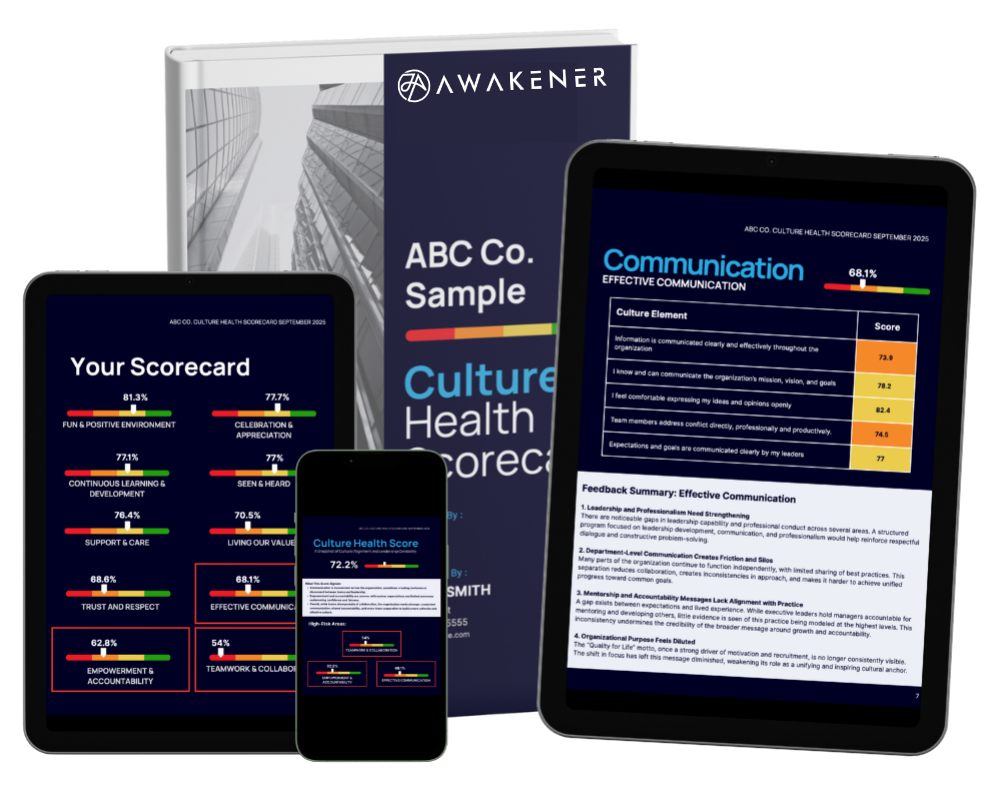
Your Culture Health Scorecard measures how your team thinks, acts, and interacts across ten core attributes. Every attribute matters. But they do not all influence your culture with the same force. To reflect this, your Scorecard uses a weighted impact model. Some attributes drive alignment and performance. Others reinforce consistency. Others shape your team's daily experience.
These differences are organized into Impact Tiers:
Tier 1. Core Drivers: Attributes that have the strongest influence on culture health and performance. Strengthen these, and the entire system improves. Trust & Respect, Living Our Values, Effective Communication, Empowerment & Accountability, Support & Care
Tier 2. System Strengtheners: Attributes that reinforce alignment, collaboration, and clarity across the team. Teamwork & Collaboration, Seen & Heard, Continuous Learning & Development
Tier 3. Cultural Atmosphere: Attributes that shape the everyday experience, energy, and morale of your team. Celebration & Appreciation, Fun & Positive Environment
Cost of Culture
Culture isn’t a soft metric—it’s a bottom-line driver.
When ignored or misaligned, culture quietly becomes
one of the most expensive liabilities in your organization.
Turnover
- The #1 reason people leave jobs isn’t pay—it’s culture. (MIT Sloan)
- Replacing a single employee costs up to 2x their salary. (Gallup)
- Toxic cultures lead to up to 3x higher turnover rates. (SHRM)
- Only 2 in 10 employees strongly agree that their culture connects them to their work. (Gallup)
Productivity Loss
- Disengaged employees are 18% less productive. (Gallup)
- “Presenteeism” (employees showing up but not contributing) costs U.S. businesses $1,500 to $5,000 per employee annually. (Harvard Business Review)
- Silos, confusion, and lack of clarity kill momentum and innovation. (McKinsey & Co.)
Leadership Gaps
- Without cultural clarity, managers default to managing tasks, not leading people.
- Teams follow inconsistent norms, causing misalignment and morale issues.
- Leaders spend 30–50% of their time dealing with people problems that are really culture problems. (Deloitte)
The Culture Health Scorecard reveals the silent leaks and equips you to build a team
people never want to leave—and a culture that fuels performance, not frustration.
Contact us to Provide This Tool
to Your Organization


Jose Oliver
With a background in Electronic Engineering, Mr. Oliver started his career as a sales engineer for organizations with customers around the world and serving in different industries, and he exceeded sales quotas every year. With an entrepreneurship spirit, he started and led a company for 3 years that evolved from a consulting firm to a systems integration (machine builder) company, where he led up to 25 people at the peak of this company’s growth journey. He was invited to join a larger systems integration corporation and moved to the United States to get closer to the company’s operations team. With a spirit of servanthood, he studied and got certified in several disciplines to start a new organization that aims to provide personal and organizational behavior enhancement tools applied to Leadership.
His experience in the Leadership training arena as facilitator include 360 degree leadership assessments at the Air-Force, training mid-level managers on leadership skills, and deployment of online training sessions for personal growth. His certifications include Maxwell Leadership, DISC Advanced Behavioral Analysis Consultant, Dr. Amen’s Brain Health Coach, EQ Project, and OKR Professional, among others.